
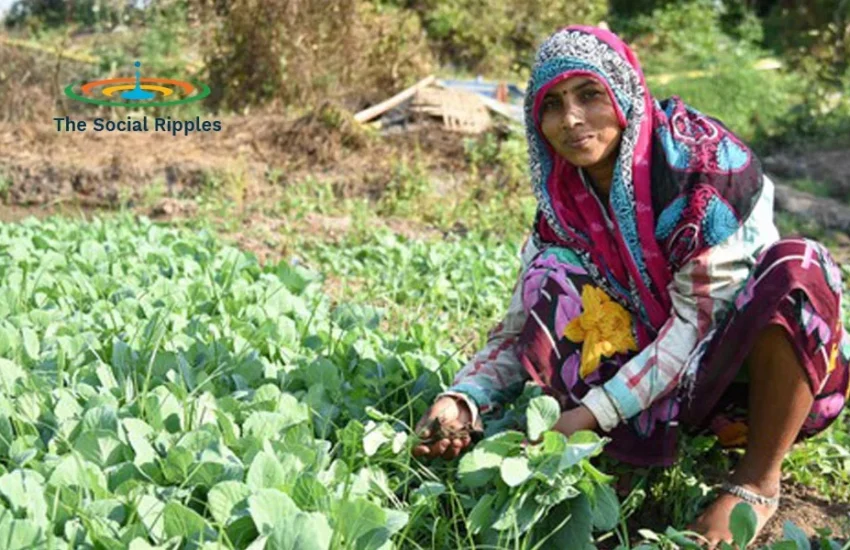
A journey through the countryside is blissful and soothing for the mind and heart.
Oh! what beauty embellishes the lush green or ripe golden crops swaying in rhythm as the breeze blows.
It’s a scenic beauty straight from fairytales—raw, organic and deeply rooted in India’s agricultural heritage.
India’s Countryside Beauty and Agricultural Soul
Women bending and tending to the crops—sowing, harvesting, nurturing—create a vibrant, living canvas of rural life. As if a divine script written by the Master Creator.
A walk along the misty hills of Darjeeling or Ooty on their winding paths feels almost unreal. Bamboo baskets resting on the shoulders of women plucking tea leaves remain a timeless spectacle.
The glowing yellow mustard fields across Punjab continue to symbolize abundance and prosperity.
Apple orchards and strawberry farms across Shimla’s mountainous terrain draw tourists with an almost magnetic charm.
Yet, behind this breathtaking rural beauty lies relentless human effort.
Most of this natural splendor exists because of the back-breaking, long hours spent by women farmers—working tirelessly in fields, nurturing soil, sustaining livelihoods and feeding a nation.
Women Farmers Driving India’s Food Security
Today, women make up nearly 65–70% of the agricultural workforce in India, depending on region and crop type. They contribute significantly to food production, often accounting for 60–80% of food production activities in developing economies.
Yet, they largely remain invisible.
Ground Reality: Gender Inequality, Land Rights and Financial Exclusion
The narrative of women empowerment risks remaining confined to policy documents and political speeches unless it transforms the everyday realities of those living on the margins.
These are women whose day begins before sunrise and ends long after dusk—the unseen backbone of India’s agrarian economy.
They continue to face systemic barriers: gender discrimination, entrenched patriarchy, limited land ownership and lack of institutional support.
Migration has intensified this imbalance. Large numbers of men move to urban centers in search of work, leaving women to manage both households and farms.
Women farmers shoulder dual responsibilities—domestic work and agricultural labor—often without wages, especially on family-owned land. One key reason is the continued lack of equitable land inheritance for daughters, despite legal provisions.
Even today, less than 14% of operational landholdings in India are owned by women, severely limiting their access to credit, insurance and government benefits.
The economic returns of their labor often flow to male family members. Those working as laborers are typically paid significantly less than men for similar work.
Without land titles, women farmers struggle to access institutional finance. This restricts their ability to scale operations, invest in technology, or achieve financial independence.
As a result, many are excluded from official farmer records and remain outside the reach of government schemes like PM-KISAN or crop insurance programs.
This stark reality creates a painful paradox: those who contribute immensely to household income, national food security and rural sustainability often live in poverty and social vulnerability.
Such economic dependence increases their exposure to domestic violence, limits their access to education and restricts their ability to assert fundamental rights.
And yet—change is quietly taking root.
Stories of Change: Women Farmers Leading Rural Transformation
Across India, stories of resilience are emerging.
Women like Kamala Pujari, who preserved indigenous seeds and earned national recognition and Rajkumari Devi, who transformed rural livelihoods through food processing, stand as powerful symbols of grassroots transformation.
In drought-prone regions like Osmanabad in Maharashtra, villages such as Hinlajwadi tell a different story—one of collective strength.
Faced with agrarian distress and climate challenges, women farmers united, organized themselves into Self-Help Groups (SHGs) and rebuilt their economic ecosystems.
They collaborated, engaged with local administration, worked their own lands, diversified income streams and gradually shifted power dynamics within households.
Today, such villages boast hundreds of SHGs, collectively generating turnovers exceeding ₹1 crore annually.
Women are no longer limited to farming—they are running dairy units, poultry farms, tailoring businesses and rural enterprises.
What is equally remarkable is the social shift.
Men, who once resisted change, are now sharing household responsibilities—an understated yet powerful transformation in rural gender roles.
This evolution highlights one truth: when women are empowered economically, entire communities progress.
However, scaling such success requires structural change.
The Way Forward: Policy, Empowerment and India’s Agricultural Future
Women farmers need stronger institutional support—clear land rights, easier access to credit, better market linkages and targeted capacity-building programs.
Government interventions must go beyond policy design to effective implementation. Financial institutions must be mandated to improve credit accessibility for women without traditional collateral.
Education—both formal and skill-based—must reach rural women at scale.
Equally important is the role of grassroots institutions.
NGOs, SHGs and gram panchayats must continue driving awareness, breaking patriarchal norms and building local leadership among women.
India already has over 80 lakh SHGs under the National Rural Livelihood Mission (NRLM), representing one of the world’s largest women-led community networks.
These networks hold immense potential to accelerate socio-economic transformation.
At the systemic level, governance must address inefficiencies—plug leakages, ensure accountability and strengthen last-mile delivery mechanisms.
Judicial and administrative backing will be essential to enforce rights and entitlements.
Because the future of India’s agricultural sustainability is inseparable from the empowerment of its women farmers.
A nation that feeds billions cannot afford to neglect those who nourish its soil.
The vision of true women empowerment—and a self-reliant India—will only be realized when women farmers are recognized, respected and resourced as equal stakeholders.
As Food and Agriculture Organization rightly emphasizes:
Providing women farmers equal access to resources could increase agricultural yields by up to 30% and lift nearly 100–150 million people out of hunger globally.
This is not just a moral imperative. It is an economic, social and national necessity. Because when women farmers rise, India rises with them.
About the Author
Dr. Lopamudra Priyadarshini is Head – CSR & Sustainability (Copper Business), Hindalco Industries Ltd., working on community resilience, institutional strengthening and shared value frameworks in CSR and ESG strategy that position CSR as a strategic pillar of long-term business and societal transformation.
