

A Decade of CSR in India From Mandate to Momentum
Corporate Social Responsibility in India has travelled a remarkable journey in the decade since the Companies Act, 2013 made CSR spending mandatory for eligible companies. The institutionalisation of CSR is often cited as one of India’s most innovative policy contributions to contemporary develop ment models. It has enabled a large-scale, structured flow of corporate resources into social sectors ranging from education and health to environment restoration, skilling and livelihood promotion.
In FY 2023–24, the total CSR expenditure crossed 34,000 crore, reflecting a year-on-year growth of nearly 13–16%. Corporations are not merely spending more, they are increasing ly aware of the social license to operate, reputation risks, changes in stakeholder expectations and the interconnectedness of business and social ecosystems.
Yet, beneath this picture of expanding reach and rising investment lies a more subtle, more complex question: Is CSR truly trans forming communities, or are we mostly funding activity without cultivating sustained change?
The Hidden Gap Between CSR Investment and Real Impact
The contradiction becomes visible when one visits villages long after CSR projects conclude. In many parts of rural and peri-urban India, it is not uncommon to find infrastructure created with good intentions, training centres that once.
Buzzed with activity but now remain closed, sanitation units that stand unused because water access was never integrated, livelihood machines that gather dust because market linkages were never established, or women’s groups that formed but did not federate into sustained enterprises.
These results are not failures of effort or commitment. They are failures of design specifically, who designs CSR projects, how decisions are made, whose agency frames the solution, and who holds ownership once the corporate cycle shifts.
The critical observation emerging from years of grounded experience in CSR practice is simple yet transformative: Most CSR in India is still designed for communities, not with them. And this single distinction often decides whether an intervention will sustain beyond the funding period, build community capacity and strengthen local institutions or fade out once corporate involvement reduces.
When Good Intentions Fail on Ground Reality
Designing CSR for communities typically follows a top-down logic. Need assessment takes the form of baseline surveys conducted by external agencies. Project design is drafted in offices far from the rhythms of the local community. Implementation is handled by NGOs or technical partners who may vary in their depth of engagement.
Monitoring focuses largely on counting the number of trainings conducted, beneficiaries enrolled, or assets created. Reporting emphasises spending utilisation and quantitative achievements because those are easiest to track and present. What often remains missing in this model is the community’s voice in defining priorities, the community’s role in governance, and the community’s ownership of the process and its outcomes. Without these, sustainability becomes fragile; the project may be technically sound but socially shallow.
Why Designing For Communities Falls Short
Consider a sanitation initiative in a rural tribal region, where toilets were constructed, awareness campaigns conducted, and behaviour change materials distributed. For some months, usage numbers were promising. Yet, within two years, many structures fell into disuse. The reason was not cultural resistance, as is often assumed.
It was technical and institutional: Water access had not been integrated, no local committee had been formed to govern upkeep, no clarity existed about maintenance responsibilities, and the project had not been embedded in the local governance system. The community had been a recipient, not a co-creator. With no sense of ownership, the infrastructure simply did not sustain. This case reflects a broader national pattern: billions of rupees of CSR funds have created assets without parallel creation of social ownership structures.
Case Study – Community Led Transformation That Sustains
Now contrast this with an agroforestry and livelihood regeneration project in a tribal belt in central India. Before any physical intervention began, the CSR team and partner facilitators conducted months of listening not surveys, but dialogue circles, informal conversations, women’s gatherings, youth collectives and household storytelling. The question was not, “What do you need?”, but “What do you value, what do you depend on, what is threatened and what do you want to strengthen for your children?”
Women’s self-help groups were invited to map their seasonal livelihood calendars, identify risk points and prioritise income diversification strategies. A village resource committee was formed, not as an advisory group but as a decision-making body, co-chaired by community representatives. Women from the village were trained as monitoring cadre documenting sapling survival rates, soil moisture levels and income variations.
Within three years, the project had transitioned from CSR-led to community-governed. Household income from forest produce rose, village-level nursery operations became independent, and the community itself institutionalised rules for forest conservation. Here, CSR acted not as provider, but as enabler of agency. The intervention sustained because ownership resided in the community.
Case Study – Participation Without Power Fails Outcomes
A third reflection comes from a youth skilling initiative in an industrial corridor. The programme enrolled young adults, partnered with a technical training agency and placed trainees in jobs across states. However, attrition rates were high after placement. The reason became clear in retrospect: While youth groups had been “consulted,” they had not been empowered to decide which sectors, trades or employers aligned with their aspirations, mobility constraints and cultural contexts. Consultation without decision-making power is not participation it is symbolic involvement. Participation requires shifting influence, not merely conduct-ing meetings.
These three cases, taken together, illustrate that sustainability is not a function of funding; it is a function of ownership. When communities participate only as recipients, CSR creates temporary improvement.
When communities participate as design ers, governors and custodians, CSR creates lasting transformation. Participation is not a technical component of CSR; it is an ethical stance. It acknowledges that communities are not empty vessels waiting to be filled with solutions. They are knowl edge systems, social networks, ecological memory and lived experience all of which companies must honour and work with.
Ownership Not Funding Defines Long Term Impact
The argument for designing CSR with communities is also aligned with national development imperatives. India’s most successful public development missions from Mission Shakti in Odisha to Nation al Rural Livelihoods Mission did not succeed because external experts delivered solutions. They succeeded because they built institutions that enabled communities to lead their own development journey. Similarly, climate resilience one of the most urgent questions of our time — cannot be built through externally imported models alone. Communities living in ecologically fragile regions already possess embedded adaptive knowledge. CSR must learn from that knowledge, not overwrite it.
Aligning CSR With National Development and Climate Realities
There is also a strategic dimension at play. CSR designed with community participation strengthens social license to operate. It reduces conflict, enhances trust, supports seamless business operations, contributes to workforce stability, and deepens corporate reputation. When communities perceive CSR as partnership rather than charity, the relationship between company and community becomes mutual, rather than extractive or transactional. In an era where corporates are increasingly evaluated not only on profit but on conduct, legitimacy and contribution, participation is strategic, not merely ethical.
Five Shifts That Will Define the Future of CSR in India
The future of CSR therefore requires five shifts in practice.
1. Companies must learn to listen longer and plan later, allowing community realities to shape priorities rather than project cycles.
2. They must move from designing solutions to co-designing pathways.
3. Local governance bodies women’s collectives, farmer cooperatives, youth groups, panchayats must play governing roles, not supportive ones.
4. Monitoring must shift from counting outputs to tracking change that communities define as meaningful: confidence, agency, income security, ecological stability and collective problem-solving.
5. Exit strategies must be embedded from the beginning, with clear roadmaps for transition of responsibility to local institutions.
The Fundamental Truth About Community Led Development
CSR is not an act of giving. CSR is a relationship of shared stewardship. The question for CSR leaders today is no longer, “What can we provide to commu nities?” It is, “What power are we willing to share? Whose voice will we centre? Whose knowledge will we honour? And how will we ensure that when our funding recedes, the initiative intensifies rather than collapses?”
We do not build communities. Communities build themselves. Our role is to stand beside them to strengthen their capacity to govern their own futures and to learn from their wisdom as much as we offer ours.
About the Author
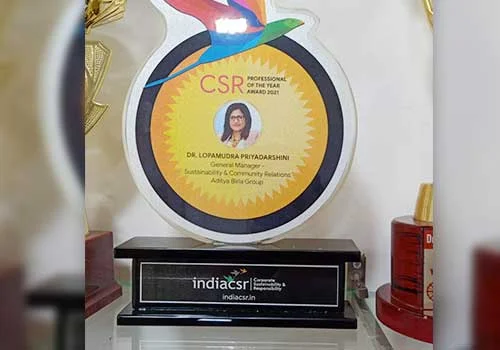
Dr. Lopamudra Priyadarshini is Head – CSR & Sustainability (Copper Business), Hindalco Industries Ltd., working on community resilience, institutional strengthening and shared value frameworks in CSR and ESG strategy that position CSR as a strategic pillar of long-term business and societal transformation.
