
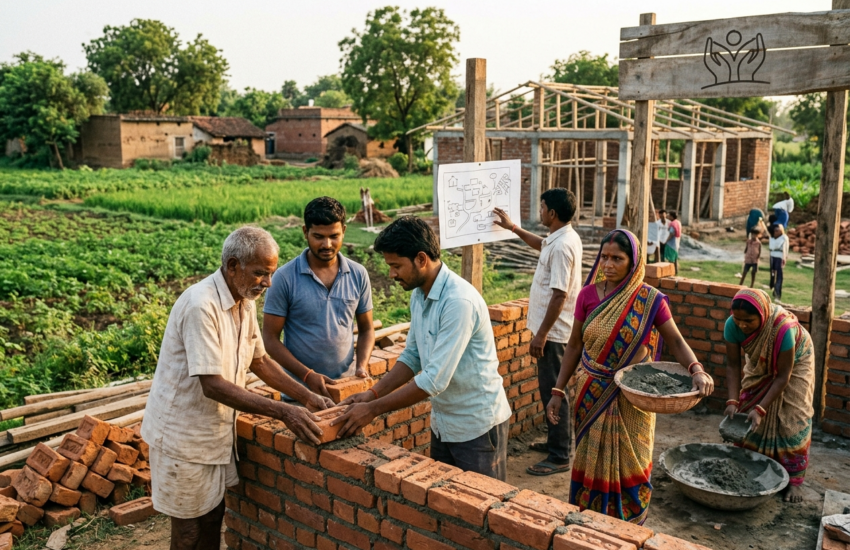
A village where I have worked for over a decade received four different CSR interventions in five years, a health camp, a school renovation, a solar lighting project, and a livelihood scheme. Each one looked good on a report. Yet when the funding cycle ended, three of the four quietly stopped functioning, because no one in the village had ever been asked to run them. This is the uncomfortable truth at the heart of India’s CSR story: we have built infrastructure faster than we have built ownership.
The Scale of the Problem, in Numbers
India’s corporate social responsibility spend has grown dramatically, from ₹10,066 crore in 2014-15 to a record ₹34,909 crore in 2023-24, more than tripling in a decade (CAalley, citing MCA data). That is a remarkable commitment of capital toward social good. But look closer at where it goes: education and healthcare now absorb more than 55% of total spending, up from 44% ten years ago, while rural development has seen its share consistently decline over the same period (CAalley, 2026).
Even more telling is the geography. Over 60% of CSR funds concentrate in just six states, Maharashtra, Tamil Nadu, Karnataka, Andhra Pradesh, Gujarat and Delhi, while less-industrialised regions receive a fraction of the attention their populations need (Deccan Herald, 2026). Only about 30% of eligible rural districts receive CSR support that actually aligns with their development needs, according to the Development Intelligence Unit’s Rural Quality of Life analysis across 69 indicators. Companies invest where their factories sit, not where the need is greatest.
This is precisely the gap I have spent my career trying to close, moving CSR from a compliance exercise toward genuine community ownership.
A Closer Look: What Happens When Ownership Is Missing
I have walked into villages where solar streetlights, installed with genuine good intent, stood dark within eighteen months. That’s because no local technician had been trained to replace a faulty inverter. And no village fund existed to pay for the part.
The same pattern repeats with borewells, community halls, and even health camps: the asset arrives, the ribbon is cut, the photographs are taken. After that, the implementing partner moves to the next village on the list. Nationally, this pattern is even visible in the data. Sectors like disaster management and slum development saw spending fall by roughly 75 to 77% in recent years. This is reflecting a broader shift away from sustained, ground-level engagement toward shorter, more visible interventions.
What Real Community Ownership Looks Like
Consider the example of Srinivasan Services Trust, the social arm of TVS Motor Company. More than 30 years of rural development work across over 2,500 villages and 16 lakh lives,. After that SST found that sustainable transformation depends on how effectively community ownership, strong local processes, and public systems work together.
Their model runs on Oor Kootams, village meetings. Here women, farmers, youth and local leaders collectively decide priorities using Participatory Rural Appraisal. That’s rather than a corporate office deciding on their behalf.
I have seen this principle validated at a much larger scale too. In May 2026, Reliance Foundation and the Observer Research Foundation released findings from a ten-year study. The study was spanning nearly 3,000 villages across Balangir in Odisha, Mandla, Adoni, and Radhanpur.
The study concluded that strong local institutions, not external funding alone. And that’s what is actually driving villages toward becoming what they call an “Atmanirbhar Gaon,” or self-reliant village. Sudarshan Suchi, Chief Development Officer of Reliance Foundation, put it during the roundtable. Asserted that an Atmanirbhar Gaon is built when communities find their own voice and co-create solutions rather than receive them.
This is the same conviction I bring into every CSR strategy I design. Whether it’s a women’s Self-Help Group in Odisha managing its own micro-enterprise fund, or a tribal community taking charge of water conservation infrastructure long. I help guide them even after the implementing NGO has exited.
Three Shifts Every CSR Leader Must Make
From beneficiaries to co-owners. A school built without the village’s involvement in maintaining it will crumble within a few monsoons. A school built with a parent committee trained to manage its upkeep survives generations. I have watched this distinction play out repeatedly in rural development projects across Odisha and Gujarat.
From project cycles to institutional capacity. CSR budgets typically run in one-to-three-year cycles, but self-reliance takes far longer to root. The ORF-Reliance Foundation study’s core insight after ten years of tracking 2,100+ households was unambiguous: strong local institutions, not one-off interventions, are what sustain outcomes.
From convenience to need. As DIU Director Sandeep Ghosh rightly noted, companies should invest money where it’s needed, not necessarily where their factory happens to sit (Deccan Herald, 2026). This single shift in mindset, from proximity-driven CSR to need-driven CSR, is where I believe corporate India has the most room to grow.
From external agencies to local capacity building. Roughly 65% of India’s CSR funds, close to ₹19,000 crore, are routed through external implementing agencies rather than built into local institutions directly (Mission Sustainability, 2026). There is nothing wrong with expert partners; I rely on them too. But when every rupee flows through an outside agency with no mandate to transfer skills locally, the village never develops the muscle to sustain the work independently once that agency exits.
Why This Matters Beyond Compliance
CSR was never meant to be a checkbox against the Companies Act’s mandated 2% spend. It is one of the most powerful tools we have to close India’s rural-urban divide, if we choose to wield it with community agency at the centre rather than corporate convenience. My own work across women empowerment, tribal upliftment, and inclusive society building has convinced me that the villages which endure are the ones where local people, not outside experts, ultimately hold the decision-making power.
The question for every CSR head, ESG strategist, and corporate foundation reading this is simple: are your interventions designed to be run by the community once you leave, or are they designed to need you forever? If it’s the latter, you haven’t built a self-reliant village. You’ve built a dependency.
I regularly speak on this subject at global CSR and ESG forums. I would welcome the opportunity to bring this community-ownership framework to your next seminar, boardroom, or sustainability summit.
If your organisation is ready to move from CSR compliance to genuine, lasting rural transformation, connect with me to discuss how we build it together.
About the Author
Dr. Lopamudra Priyadarshini is a CSR, ESG, and Sustainability leader with 25+ years of experience across corporate and government bodies, currently leading CSR and Sustainability for Birla Copper (Aditya Birla Group). She has been recognised as India’s CSR Professional of the Year, is a Certified Corporate Director and licensed CIPD (UK) member, and serves on the National CSR Network’s Health & Wellness Core Team and the Odisha Corporate Foundation.
