
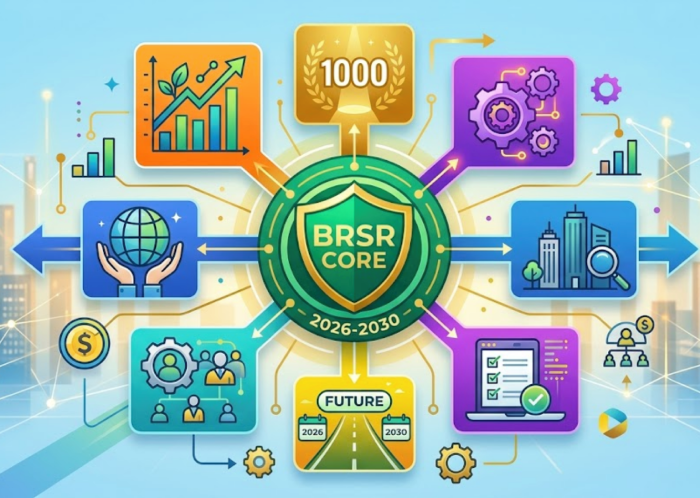
One number should already be on your compliance calendar: FY 2026-27. That is the year SEBI’s BRSR Core 2026 reasonable-assurance mandate expands from the top 500 listed companies to the top 1,000 listed companies by market capitalisation – nearly doubling the companies in scope in a single year. If your board hasn’t discussed this yet, you are not late. But the window to prepare properly, rather than scramble, is closing.
This is written for the people who will actually be accountable for it: CEOs, CFOs, Company Secretaries and CSR/ESG heads at BRSR Core top 1000 companies currently ranked anywhere near the top 1,000 by market cap – whether you’re comfortably inside that band today or climbing toward it.
I have spent three decades at the intersection of corporate ESG strategy and on-ground execution – inside CSR leadership at large Indian conglomerates, including my current role within the Aditya Birla Group ecosystem and outside them, advising boards on how SEBI ESG reporting and disclosure obligations translate into real accountability. The pattern I see repeatedly: legal and compliance teams know the deadline; very few C-suites have connected BRSR Core to what it actually demands operationally, financially and reputationally, until an auditor or investor asks the wrong question at the wrong time.
What Exactly is BRSR Core?
BRSR Core is a tightly defined subset of the Business Responsibility and Sustainability Report – nine ESG attributes covering emissions, water, waste, energy, gender diversity, wages, inclusive development, openness of business and customer disclosures. What separates it from the rest of the BRSR filing is one word: assurance. While the broader BRSR is largely self-attested, achieving BRSR Core assurance requires “reasonable assurance” – the highest standard of third-party verification, materially stricter than the “limited assurance” many frameworks use and even higher than what the EU’s CSRD initially demanded.
BRSR Core – Applicability Timeline Every Board Should Know
| Financial Year | Companies Covered (by Market Cap) |
| FY 2023-24 | Top 150 listed entities |
| FY 2024-25 | Top 250 listed entities |
| FY 2025-26 | Top 500 listed entities |
| FY 2026-27 | Top 1,000 listed entities |
If your company sits outside the top 500 but is climbing – via market cap growth, index reclassification or a recent listing – you could cross into mandatory assurance sooner than your calendar assumes. SEBI assesses ranking annually, so a company outside scope a year ago can find itself squarely inside it with no change to its own reporting.
Separately, value chain disclosures (upstream/downstream partners representing up to 75% of purchases or sales) apply to the top 250 entities, but SEBI’s March 2025 circular eased this to voluntary, comply-or-explain through FY 2026-27. Don’t read “voluntary” as “ignorable” – larger customers and lenders are already using this data to score risk.
Why BRSR Core Must Be On CEOs, CFOs Top Agenda
- It changes what “audit-ready” means. ESG data now faces financial-statement-grade scrutiny – controls, evidence, a signed opinion.
- It is priced into capital access. Investors and lenders increasingly ask for the assurance certificate itself before extending capital.
- It reshapes supply chains. Even sub-1,000 companies get pulled in as customers request BRSR-aligned data from vendors.
Common Gaps I See in Boardrooms
- Fragmented ESG data ownership across HR, procurement and CSR teams
- Manual, spreadsheet-based tracking with no audit trail
- CSR spend framed as philanthropy, not strategy
- No internal controls testing before auditors arrive
- BRSR Core treated as a sustainability-team task, not a board-level disclosure
How Forward-Looking Companies Are Getting Ahead
The companies that file smoothly built a single owner for ESG data and ran internal readiness checks before the auditor showed up – designing CSR spend so it compounds into real business value instead of sitting as a cost centre. Well-governed companies are already running mock assurance exercises a full cycle ahead of their applicability year.
Frequently Asked Questions
Which companies must comply in FY 2025-26 and who’s next?
Top 500 by market cap now; top 1,000 from FY2026-27. Rankings are reassessed annually, so proximity to the threshold matters even if you’re not in scope today.
What’s the real difference between BRSR vs BRSR Core?
BRSR is self-attested. BRSR Core adds reasonable assurance on nine KPIs – third-party testing of controls and evidence, not just a numbers review. That’s the compliance jump boards underestimate.
Is value chain reporting mandatory right now?
Voluntary for the top 250 through FY2026-27 – but large buyers are asking suppliers for it anyway, mandate or not.
What actually goes wrong when companies wait?
Not the filing – the assurance. Gaps surface when the auditor arrives, the most expensive time to find them.
Where should a CEO or CFO start this quarter?
Ask: “Who owns each BRSR Core metric end-to-end and could it survive an audit today?” If no one has a confident answer, that’s your starting point – 12–18 months before your applicability year.
BRSR Core – Let’s Connect for a Board Conversation
BRSR Core rarely catches companies off guard because the rules were unclear – it’s because the conversation happens too late and too far down the org chart. I bring this exact conversation into boardrooms, CSR committees and industry forums: translating BRSR Core into governance-ready action and turning ESG spend into strategic advantage – the same shift covered in How CSR Becomes Sustained Profit, Not Just Social Good.
If you’re organising a CSR seminar, ESG roundtable or board offsite where this needs airtime, as a dedicated CSR ESG speaker in India, I’d welcome the opportunity to bring it to your table.
Invite Dr. Lopamudra Priyadarshini to Speak or Collaborate →
About the Author
Dr. Lopamudra Priyadarshini is a CSR, ESG, and Sustainability leader with 25+ years of experience across corporate and government bodies, currently leading CSR and Sustainability for Birla Copper (Aditya Birla Group). She has been recognised as India’s CSR Professional of the Year, is a Certified Corporate Director and licensed CIPD (UK) member, and serves on the National CSR Network’s Health & Wellness Core Team and the Odisha Corporate Foundation.
