
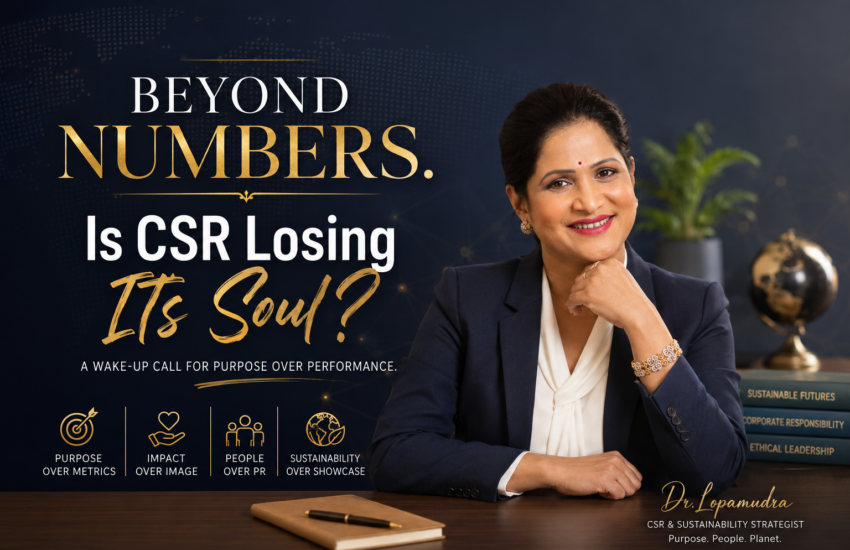
Corporate Social Responsibility (CSR) was never meant to be a performance.
At its core, CSR is a commitment. It reflects a company’s decision to contribute meaningfully to society and create opportunities that improve lives. The idea is simple. Businesses do not operate in isolation. Their growth is closely linked to the well-being of the communities around them.
Over the years, CSR has helped strengthen education, improve healthcare access, build livelihoods and support inclusive growth across India. Thousands of companies, development professionals, NGOs and community leaders continue to work tirelessly to create positive change & sustainable social impact.
Yet, an uncomfortable question deserves attention. In some cases, are we becoming more focused on demonstrating impact than creating it?
This question is not directed at any specific organisation, company, NGO or individual. Rather, it reflects a challenge of purpose over performance. A challenge that can emerge in any system where reporting, visibility and performance indicators carry significant weight towards outcome-based CSR.
As CSR continues to evolve, it may be time to examine whether we are always measuring what truly matters.
When Visibility Starts Driving Decisions
Most CSR implementation programmes begin with genuine intent. A need is identified. Baseline studies are conducted. Objectives are defined. Communities are engaged. Resources are allocated to create meaningful outcomes.
However, as projects progress, another reality enters the picture.
- CSR teams need to demonstrate results and establish CSR authenticity
- Annual reports require measurable achievements in terms of sustainable social impact.
- Stakeholders seek evidence of progress.
- Implementing agencies must showcase outcome-based CSR
None of this is wrong in terms of responsible CSR leadership, but what about stakeholder value creation? What about purpose over performance, CSR authenticity, impact versus optics? What about this accountability?
In fact, accountability is essential to responsible CSR governance. The challenge begins when visibility starts influencing decisions more than community needs.
A well-organised event often attracts more attention than months of patient fieldwork. Photographs become easier to showcase than behavioural change. Launch ceremonies receive greater visibility than long-term implementation efforts. As a result, highly visible activities may sometimes receive greater emphasis than interventions that create deeper transformation.
Reality Check – Record spending doesn’t guarantee meaningful outcomes.
Indian corporates spent ₹34,909 crore on CSR in FY24, yet multiple studies continue to highlight gaps between expenditure and measurable grassroots impact.
This is what I often describe as the performance trap in implementing outcome-based CSR.
The programme continues to function. Activities continue to take place. Reports continue to be produced. Yet the focus gradually shifts from transformation to presentation.
The difference may appear subtle, but its consequences can be significant.

Activity Does Not Automatically Mean Impact
One of the most common misconceptions in impact-driven CSR is the assumption that activity automatically creates impact.
- Conducting training programmes does not necessarily create sustainable livelihoods.
- Distributing resources does not automatically improve income levels.
- Building infrastructure does not guarantee utilisation, responsible leadership does
- Running awareness campaigns does not always lead to behavioural change.
- Real impact is more complex.
It requires evidence of mpact versus optics. Proof that people’s lives have improved in meaningful and measurable ways. It requires organisations to move beyond counting activities and begin evaluating outcomes.
- Did household income increase?
- Has school attendance improved?
- Has sustainable social impact been established?
- Did women gain greater economic independence?
- Have health indicators improved?
- Has the responsible leadership intervention continued creating value after project funding ended?
These questions are far more difficult to answer than counting participants or events. Yet they are the questions that determine whether a programme has truly succeeded.
Did you know: More than 1,871 listed companies implemented over 51,900 CSR projects during FY24, increasing the need for rigorous CSR impact measurement and outcome tracking.
This is where structured sustainable social impact assessment becomes essential. Strong CSR implementation is not measured by the number of activities completed. It is measured by the quality of change created. Effective organisations invest in evidence, beneficiary feedback and long-term outcome tracking to understand whether meaningful progress has occurred.
This is also where robust CSR impact measurement frameworks become critical. Without evidence-based evaluation, it becomes difficult to distinguish activity from actual change.
The ultimate goal should always be sustainable social impact, not simply successful reporting of corporate trust.
The Importance of Asking Difficult Questions
Every mature CSR ecosystem must be willing to ask difficult questions.
- What worked towards a real outcome-based CSR?
- What did not work as meaningful CSR initiatives?
- Why did certain outcomes fall short?
- What assumptions proved incorrect regarding ethical governance?
- What changes are needed going forward for stakeholder value creation?
Unfortunately, many organisations find it easier to celebrate corporate trust successes than discuss challenges. Yet development work has never been a linear journey.
Communities are complex, so human behaviour is complex & social systems are more complex.
Not every intervention will succeed exactly as planned.
The most credible organisations understand this reality. They recognise that transparency about challenges does not weaken trust. It strengthens it.
Modern CSR monitoring and evaluation systems are designed to move beyond activity reporting. They help organisations understand what is creating results, what requires improvement and where resources can generate greater value. Without strong monitoring mechanisms, even well-intentioned programmes can struggle to deliver measurable outcomes.
In my experience, stakeholders are more likely to trust organisations that openly discuss lessons learned than organisations that claim every initiative was a complete success.
Authenticity remains one of the strongest foundations of credibility.
When Familiar Systems Become Comfortable Systems
Another challenge emerges when programmes continue for many years without rigorous review.
Over time, established systems can create a sense of comfort via corporate trust for everyone involved. CSR teams become familiar with existing partners. Implementing agencies become familiar with reporting expectations. Community representatives become familiar with programme structures. There is nothing inherently wrong with long-term partnerships. In fact, continuity often supports stronger outcomes.
The risk arises when familiarity reduces scrutiny.
- When governance mechanisms become routine, critical questions may be asked less frequently.
- When processes remain unchanged for years, opportunities for improvement can be overlooked.
Thus, strong CSR governance matters and so does outcome-based CSR,.
Good governance is not about creating obstacles. It is about ensuring that programmes remain accountable, transparent and aligned with their intended purpose of stakeholder value creation.
Financial transparency, beneficiary verification, impact assessment and periodic programme reviews should not be viewed as administrative burdens. They are essential tools for protecting the integrity of CSR investments.
Periodic reviews are now considered among the most important CSR best practices India can adopt. Independent assessments, governance reviews, beneficiary validation and transparent reporting help ensure that programmes remain aligned with their original objectives while strengthening stakeholder confidence.
Strong CSR accountability is not about finding fault. It is about ensuring that resources create the maximum possible value for communities as well as true corporate trust.
Remembering Who the Real Stakeholder Is
Perhaps the most important question in any Corporate Social Responsibility initiative is also the simplest.
Who is this programme really for?
The answer should always be the beneficiary.
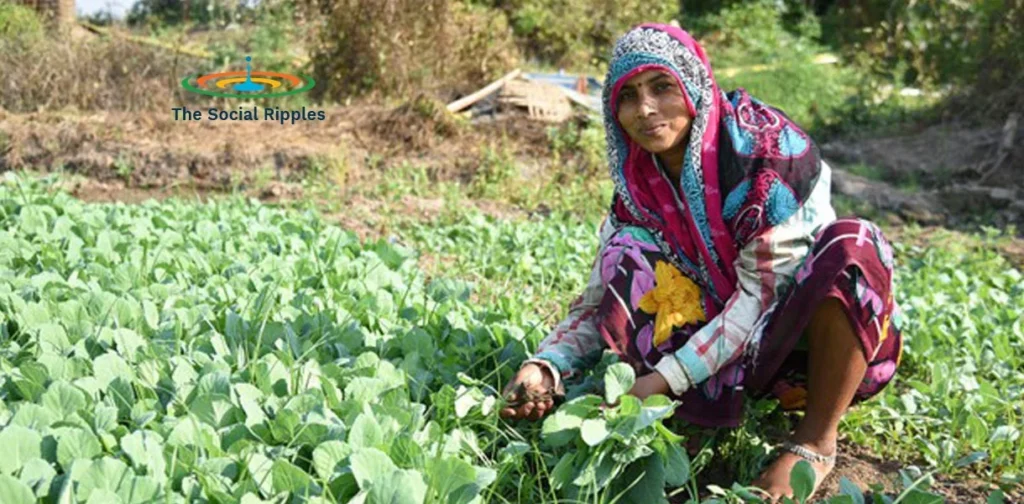
- The farmer seeking better income opportunities.
- The woman building financial independence.
- The child accessing quality education.
- The youth searching for meaningful employment.
- The person with disability striving for dignity and inclusion.
This philosophy lies at the heart of beneficiary-centric development.
When programmes become overly focused on visibility, beneficiaries can unintentionally become participants in activities rather than partners in change.
True community development works differently. It creates ownership, builds local capacity and strengthens community leadership. Furthermore, it enables people to continue progressing long after a project concludes.
Every successful development initiative should ultimately contribute to sustainable social impact. The objective is not simply to deliver services during a project period. The objective is to create conditions where individuals, families and communities can continue progressing long after direct support has ended.
The ultimate success of CSR is not dependency. It is empowerment.
The Shared Responsibility of CSR Leaders and Implementing Agencies
Responsibility for meaningful impact does not belong to one stakeholder alone.
Companies, CSR leaders, implementing agencies, community organisations and development professionals all play important roles.
- Strong CSR leadership requires creating systems that reward honesty rather than presentation.
- Implementing agencies must prioritise community outcomes over donor expectations.
- Monitoring frameworks must focus on meaningful indicators rather than activity counts alone.
- Evaluation mechanisms must encourage learning rather than simply confirming success.
- Most importantly, everyone involved must remain willing to challenge assumptions.
- The strongest CSR ecosystems are not those where problems never exist.
- They are those where problems can be identified, discussed and resolved openly.
- That culture of accountability is what ultimately drives better outcomes.
- It is also what strengthens long-term CSR transparency and institutional trust.
Rebuilding Trust Through Transparency
As CSR evolves, expectations around governance, ESG alignment, accountability and measurable outcomes will continue to increase — This is a positive development.
The future of CSR will not be defined by larger events, bigger stages or more polished presentations. It will be defined by evidence, transparencya nd measurable improvements in people’s lives.
- Trust grows when data can be verified; when finances are transparent.
- Faith grows when beneficiaries are known beyond numbers and reports.
- Trust grows when impact speaks louder than publicity.
Organisations that combine strong CSR governance, rigorous CSR monitoring and evaluation and transparent social impact assessment frameworks are often better positioned to create sustainable social impact. These systems strengthen decision-making while ensuring that resources remain focused on genuine community outcomes.
This is the foundation of lasting CSR accountability and meaningful CSR transparency.
Returning to the True Purpose of CSR
The true measure of CSR is not the number of events conducted.
It is not the number of photographs captured. Or the number of presentations delivered.
The true measure is whether lives improved.
- Opportunities expanded.
- Dignity increased.
- Resilience improved.
- Change lasts beyond the project itself.
CSR was never intended to be a showcase. It was intended to be a catalyst for transformation.
Read my article: CSR Is Not a Cost But an Essential Business Strategy
As professionals working within this sector, perhaps the most important question we can continue asking ourselves is this:
Are we creating genuine change or are we becoming increasingly skilled at creating the appearance of change?
The answer may shape not only the future credibility of CSR, but also the trust that society places in it. And ultimately, trust remains the most valuable outcome any CSR initiative can earn.
What are your views? Write to me.
Connect with Dr Lopamudra For Empowering Your CSR Goals
In today’s ESG-driven economy, governance is not complete without gender equity—and leadership without inclusion is no longer considered sustainable.
As organizations across Gujarat and India rethink sustainability, experts like Dr Lopamudra Priyadarshini ESG Expert continue highlighting a simple but powerful truth – Gender representation in leadership is now a direct measure of governance strength under ESG frameworks. To Learn more how your organisation can also leverage the power of the G in ESG, connect with Dr Lopamudra Today.
